

Umalusi gives update on 2026 approved qualifications
Umalusi CEO, Umalusi officials,
Assessment Bodies: DBE, DHET, IEB and SACAI Members of the media,
The Class of 2025, Ladies and Gentlemen,
1. Umalusi is South Africa’s Quality Council for General and Further Education and Training. Its mandate is outlined in the National Qualifications Framework (NQF) Act (No. 67 of 2008), as amended, and the General and Further Education and Training Quality Assurance (GENFETQA) Act (No. 58 of 2001), as amended.
2. The two Acts assign to Umalusi a range of powers and functions, including assuring the quality of qualifications that fall within the General and Further Education and Training Qualifications Sub-framework (GFETQSF), i.e. on Levels 1 to 4 of the NQF. The four qualifications are the:
a) National Senior Certificate (NSC),
b) National Certificate (Vocational) [(NCV)] L4,
c) NATED Report 190/191 Engineering Studies (N3) and
d) General Education and Training Certificate: Adult Basic Education and Training (GETC: ABET).
3. These are the qualifications for which Umalusi is legislatively obligated to assure quality. Umalusi draws its mandate in relation to the approval of the release of results from section 17A(5)(b) of the amended GENFETQA Act. The section reads as follows: -
“The Council must, with the concurrence of the Director-General and after consultation with the relevant assessment body or education institution, approve the publication of the results of learners if the Council is satisfied that the assessment body or education institution has-
(i) conducted the assessment free from any irregularity that may jeopardise the integrity of the assessment or its outcomes;
(ii) complied with the requirements prescribed by the Council for conducting assessments;
(iii) applied the standards prescribed by the Council with which a learner is required to comply in order to obtain a certificate; and
(iv) complied with every other condition determined by the Council”.
4. In line with these provisions, the Executive Committee (EXCO) of Umalusi Council met on 6-8 January 2026 to consider detailed reports from Umalusi and the four assessment bodies on the conduct, administration and management of the 2025 October/November NSC, NC(V) L4, NATED Report 190/191 Engineering Studies (N3) and GETC: ABET examinations by the respective assessment bodies.
5. This approval statement brings together decisions taken at different stages of the quality assurance cycle of Umalusi. As such, it marks Umalusi Council’s confirmation that the assessments leading to certification in public and private schools, adult education centres and technical and vocational education and training colleges were of the required standard across all qualifications.
6. One of the quality assurance processes that preceded EXCO’s approval meetings is standardisation of examination marks. The process was conducted by the Assessment Standards Committee (ASC) of Umalusi Council between 18 December 2025 and 5 January 2026. In standardising examination marks, the ASC relied on well-established standardisation principles and approaches, which are supported by numerical evidence and narrative reports. One matter worthy of explaining is that standardisation is done through statistical adjustments of mark distributions, not individual learner marks, and that the process is applied only to the external examination marks.
7. Approximately 1 026 000 candidates wrote the examinations across different qualifications and assessment bodies. In terms of breakdown, the data in Table 1 shows that, as a proportion of the total, the NSC, with over 927 000 candidates, accounted for the largest share of the total candidature.

8. The more than one million candidates wrote the examinations at about 9400 examination centres, spread across the four assessment bodies as indicated in Table 2 below.

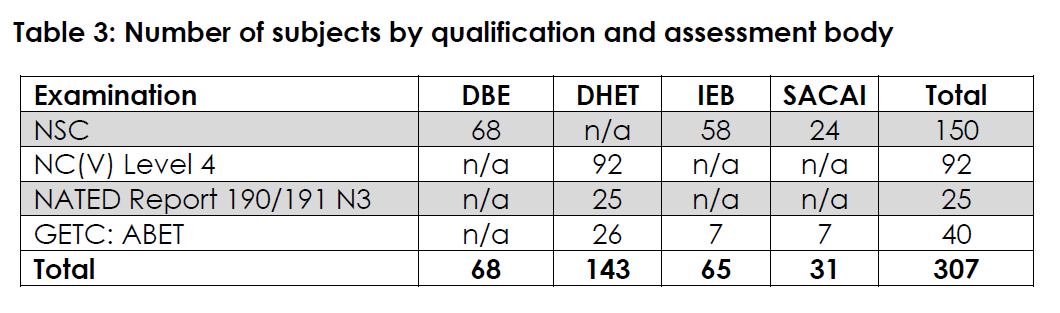
9. The information in Table 3 shows that 307 subjects were examined across the four qualifications and assessment bodies.
10. The next section presents the approval decisions of EXCO of Council for each assessment body starting with the results of the South African Comprehensive Assessment Institute (SACAI). Thereafter, I will move on to the results of the Independent Examinations Board (IEB), followed by those of the Department of Higher Education and Training (DHET) and then conclude with the results of the Department of Basic Education (DBE).
STANDARDISATION AND APPROVAL DECISIONS FOR SACAI
Standardisation of GETC: ABET results of SACAI
11. The SACAI administered its GETC: ABET examinations to 217 candidates at 21 examination centres. Table 4 shows that of the 7 learning area results presented, 6 learning areas had their results accepted in their submitted or ‘raw’ form and 1 was adjusted mainly upwards.

12. Approval statement for the release of SACAI’s GETC: ABET results
Having studied all the evidence presented, the Executive Committee (EXCO) of Umalusi Council concluded that the examinations were administered in accordance with the South African Comprehensive Assessment Institute (SACAI) policy on the conduct, administration and management of examinations. There were no systemic irregularities reported that might have compromised the overall credibility and integrity of the November 2025 General Education and Training Certificate: Adult Basic Education and Training (GETC: ABET) examinations administered by the SACAI.
EXCO of Council approves the release of the SACAI November 2025 GETC: ABET examination results. Regarding identified irregularities, the EXCO of Council endorses the SACAI’s recommendation to withhold the results of candidates who are implicated in the alleged irregularities, including acts of dishonesty.
The SACAI is required to address the directives for compliance and improvement highlighted in the Quality Assurance of Assessment report and submit an improvement plan by 13 March 2026.
EXCO of Council commends the SACAI for conducting a successful examination.
Standardisation of NSC results of SACAI
13. SACAI’s NSC examinations were administered in 24 subjects to 6 168 candidates at 83 examination centres. Based on the evidence presented during standardisation processes, the ASC arrived at the following decisions:
a) raw marks were accepted for 9 subjects (37.5%),
b) the results in 12 subjects (50%) were adjusted mainly upward, and
c) the results in the remaining 3 subjects (12.5%) were adjusted mainly downward.

14. Approval statement for the release of SACAI’s NSC results
Having studied all the evidence presented, the Executive Committee (EXCO) of Umalusi Council concluded that the examinations were administered largely in accordance with the Regulations Pertaining to the Conduct, Administration, and Management of the National Senior Certificate Examinations. There were no systemic irregularities reported that might have compromised the overall credibility and integrity of the November 2025 National Senior Certificate (NSC) examinations administered by the South African Comprehensive Assessment Institute (SACAI).
EXCO of Council approves the release of the SACAI November 2025 NSC examination results. Regarding identified irregularities, the EXCO of Council endorses the SACAI’s recommendation to withhold the results of candidates who are implicated in the alleged irregularities, including acts of dishonesty.
SACAI is required to address the directives for compliance and improvement highlighted in the Quality Assurance of Assessment report and submit an improvement plan by 13 March 2026.
EXCO of Council commends the SACAI for conducting a successful examination.
15. The details of the actual standardisation decisions at qualification and subject levels are provided in the statement as annexures. In addition to being published on the Umalusi website for wider reach, the statement will be made available to you immediately after this briefing.
STANDARDISATION AND APPROVAL DECISIONS FOR IEB
Standardisation of GETC: ABET results of IEB
16. The IEB’s GETC: ABET examinations were administered in 7 learning areas to 469 candidates at 54 examination centres. The results were standardised as follows:
a) raw marks were accepted in 4 (57.1%) learning areas,
b) mainly upward adjustments were made in 1 (14.3%), and
c) mainly downward adjustments were made in 2 (28.6%) learning areas.

17. Approval statement for the release of IEB’s GETC: ABET results
Having studied all the evidence presented, the Executive Committee (EXCO) of Umalusi Council concluded that the examinations were administered in accordance with the Independent Examinations Board (IEB) policy on the conduct, administration and management of examinations. There were no systemic irregularities reported that might have compromised the overall credibility and integrity of the November 2025 General Education and Training Certificate: Adult Basic Education and Training (GETC: ABET) examinations administered by the IEB.
EXCO approves the release of the IEB November 2025 GETC: ABET examination results. Regarding identified irregularities, the EXCO of Council advises the IEB to withhold the results of candidates who are implicated in the alleged irregularities, including acts of dishonesty.
The IEB is required to address the directives for compliance and improvement highlighted in the Quality Assurance of Assessment report and submit an improvement plan by 13 March 2026. EXCO of Council commends the IEB for conducting a successful examination.
Standardisation of NSC results of IEB
18. The IEB administered the NSC examinations to 17 414 candidates (16 063 full-time and 1 351 part-time) at 256 examination centres. Out of the 58 subject results that were presented to the ASC for standardisation,
a) raw marks were accepted in 47 subjects (81%),
b) mainly upward adjustments were made in 7 subjects (12.1%), and
c) mainly downward adjustments were made in 4 subjects (6.9%).

19. Approval statement for the release of IEB’s NSC results
Having studied all the evidence presented, the Executive Committee (EXCO) of Umalusi Council concluded that the examinations were administered largely in accordance with the Regulations Pertaining to the Conduct, Administration, and Management of the National Senior Certificate Examinations. There were no systemic irregularities reported that might have compromised the overall credibility and integrity of the November 2025 National Senior Certificate (NSC) examinations administered by the Independent Examinations Board (IEB).
EXCO of Council therefore approves the release of the IEB November 2025 National Senior Certificate examination results. Regarding identified irregularities, the EXCO of Council endorses the IEB’s recommendation to withhold the results of candidates who are implicated in the alleged irregularities, including acts of dishonesty.
The IEB is required to address the directives for compliance and improvement highlighted in the Quality Assurance of Assessment report and submit an improvement plan by 13 March 2026.
EXCO of Council commends the IEB for conducting a successful examination.
STANDARDISATION AND APPROVAL DECISIONS FOR DHET
Standardisation of GETC: ABET results of DHET
20. The DHET’s GETC: ABET examinations were written by 38 220 candidates at 1 519 examination centres countrywide. Of the 26 learning areas results presented, the following standardisation decisions were made by the ASC:
a) raw marks were accepted in 13 learning areas (50%),
b) 5 learnings (19.2%) areas were adjusted mainly upward, and
c) 8 learning areas (30.8%) were adjusted mainly downward.

21. Approval statement for the release of GETC: ABET results: DHET
Having studied all the evidence presented, the Executive Committee (EXCO) of Umalusi Council concluded that the examinations were administered largely in accordance with the National Policy Pertaining to the Conduct, Administration and Management of the Examinations of Colleges, Established, Declared or Registered in Terms of the Continuing Education and Training Act, 2006. There were no systemic irregularities reported that might have compromised the overall credibility and integrity of the November 2025 General Education and Training Certificate: Adult Basic Education and Training (GETC: ABET) examinations administered by the Department of Higher Education and Training (DHET).
EXCO of Council approves the release of the DHET November 2025 GETC: ABET examination results. Regarding identified irregularities, the EXCO of Council endorses the DHET’s recommendation to withhold the results of candidates who are implicated in the alleged irregularities, including acts of dishonesty. DHET should ensure that all irregularities are thoroughly investigated and that a full report is provided to Umalusi for verification and approval within a reasonable timeframe.
The DHET is required to address the directives for compliance and improvement highlighted in the Quality Assurance of Assessment report and submit an improvement plan by 13 March 2026.
EXCO of Council commends the DHET for conducting a successful examination.
Standardisation of NC(V) Levels 4 results of DHET
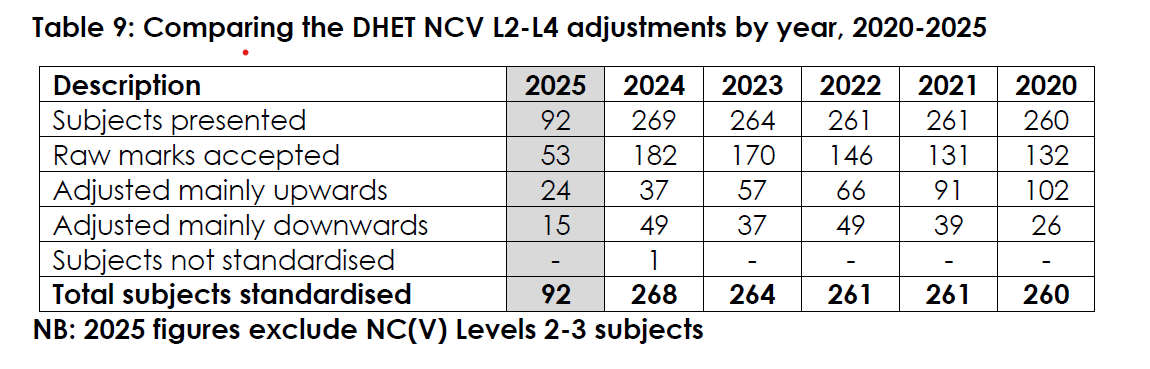
22. The NC(V) L4 examinations were written by 36 961 candidates at 248 examination centres. The standardisation decisions arrived at are as follows:
a) raw marks were accepted for 53 subjects (57.6%),
b) mainly upward adjustments were made in 24 subjects (26.1%), and
c) mainly downward adjustments were made in 15 subjects (16.3%).
23. Approval statement for the release of DHET’s NC(V) L4 results
Having studied all the evidence presented, the Executive Committee (EXCO) of Umalusi Council concluded that the examinations were administered largely in accordance with the National Policy Pertaining to the Conduct, Administration and Management of the Examinations of Colleges, Established, Declared or Registered in Terms of the Continuing Education and Training Act, 2006. There were no systemic irregularities reported that might have compromised the overall credibility and integrity of the November 2025 National Certificate (Vocational) [NC(V)] Level 4 examinations administered by the Department of Higher Education and Training (DHET).
EXCO of Council approves the release of the DHET November 2025 NC(V) Level 4 examination results. Regarding identified irregularities, the EXCO of Council endorses the DHET’s recommendation to withhold the results of candidates who are implicated in the alleged irregularities, including acts of dishonesty. DHET should ensure that all irregularities are thoroughly investigated and that a full report is provided to Umalusi for verification and approval within a reasonable timeframe.
Umalusi acknowledges the progress made by the DHET to uphold the integrity and credibility of the NC(V) L4 examinations, however the following recurrent challenges remain critical areas of concern:
• Non-compliance with ICASS instructions at various colleges;
• Decrease in the number of candidates who wrote per subject; and
• High number of colleges implicated in ISAT irregularities.
The DHET is required to address the directives for compliance and improvement highlighted in the Quality Assurance of Assessment report and submit the improvement plan by 13 March 2026.
EXCO of Council commends the DHET for conducting a successful examination and requires that the DHET takes the necessary steps to ensure the continuous improvement in the integrity of the NC(V) L4 qualification.
Standardisation of N3 results of DHET
24. In 2025 the DHET administered the N3 examinations to 23 847 candidates at 321 examination centres. The following standardisation decisions were taken for the 25 instructional offerings:
a) raw marks were accepted for 11 subjects (44%),
b) mainly upward adjustments were made in 1 subject (4%), and
c) mainly downward adjustments were made in 13 subjects (52%).

25. The above table shows that the number of subjects for which raw marks are accepted has been declining over the last four years.
In terms of Government Gazette 49518, the NATED Report 191 N1-N3 programmes entered a phase out period as from 1 January 2024. Accordingly, the last set of examinations for which Umalusi will issue N3 Certificates are the October/November 2025 examinations.
26. Approval statement for the release of DHET’s N3 results
Having studied all the evidence presented, the Executive Committee (EXCO) of Umalusi Council concluded that the examinations were administered largely in accordance with the National Policy Pertaining to the Conduct, Administration and Management of the Examinations of Colleges, Established, Declared or Registered in Terms of the Continuing Education and Training Act, 2006. The irregularities identified during the writing of the examinations were not systemic and therefore did not compromise the overall credibility and integrity of the November 2025 NATED Report 190/191 Engineering Studies N3 examinations administered by the Department of Higher Education and Training (DHET).
EXCO of Council approves the release of the DHET November 2025 NATED Report 190/191 Engineering Studies N3 examination results. Regarding identified irregularities, the EXCO of Council endorses the DHET’s recommendation to withhold the results of candidates who are implicated in the alleged irregularities, including acts of dishonesty. DHET should ensure that all irregularities are thoroughly investigated and that a full report is provided to Umalusi for verification and approval within a reasonable timeframe.
EXCO of Council commends the DHET for conducting a successful examination.
27. In this final section of the statement, we present the standardisation and approval decisions in respect of the NSC examinations administered by the DBE.
Standardisation of NSC results of DBE
28. A total of 903 561 candidates (766 543 full time and 137 018 part-time) wrote the NSC examination under the DBE. The candidates were distributed across 6 955 examination centres throughout the country. The DBE presented results of 68 subjects for standardisation, and, after careful analysis of the numerical evidence and narrative reports presented, the ASC arrived at the following decisions:
a) raw marks were accepted for 56 subjects (82.4%),
b) mainly upward adjustments were made in 7 subjects (10.3%), and
c) mainly downward adjustments were made in 5 subjects (7.4%).

29. A year-on-year comparison shows a clear pattern of an upward trend in the number of DBE subjects for which raw marks were accepted over the last five years. This is a clear signal that the system continues to produce consistent and reliable results over time.
30. Approval statement for the release of DBE’s NSC results
Having studied all the evidence presented, including the report of the National Investigation Task Team, the Executive Committee (EXCO) of Umalusi Council concluded that the examinations were administered largely in accordance with the Regulations Pertaining to the Conduct, Administration, and Management of the National Senior Certificate Examinations. There were no systemic irregularities reported that might have compromised the overall credibility and integrity of the November 2025 National Senior Certificate (NSC) examinations administered by the Department of Basic Education (DBE).
EXCO of Council approves the release of the DBE November 2025 National Senior Certificate examination results. Regarding identified irregularities, the EXCO of Council endorses the DBE’s recommendation to withhold the results of candidates who are implicated in the alleged irregularities, including acts of dishonesty.
The DBE is required to address the directives for compliance and improvement highlighted in the Quality Assurance of Assessment report and submit an improvement plan by 13 March 2026.
EXCO of Council commends the DBE for conducting a successful examination on such a large scale.
SUMMARY
31. In summary, the 2025 end of year national examinations were administered in over 300 subjects at around 9 400 examination centres. The total number of candidates is approximately 1 026 000 candidates who are distributed across four assessment bodies and four qualifications. The NSC candidates contributed 90.3% or approximately 927 000 of the total.
32. During the conduct of its quality assurance work from start to finish, Umalusi uncovered specific areas of weakness that the Council has directed the relevant assessment bodies to put in place systems to strengthen those areas.
33. While the issues will be covered in the assessment body-specific composite reports, detailing areas of best practice, areas of non-compliance, and directives for compliance and improvement, it is worth mentioning that Umalusi is seriously concerned about the recurrence of areas of non-compliance with regulations pertaining to internal assessment (Internal Continuous Assessment - ICASS and Integrated Summative Assessment Task - ISAT) particularly in the Technical and Vocational Education and Training (TVET) colleges.
34. Following repeated lapses in the conduct, administration, and management of assessments and examinations by the DHET, the Executive Committee (EXCO) of the Umalusi Council directed that the DHET be placed under close monitoring during 2025. Whereas the DHET has improved in some areas, there are areas that still need to be tightened up. In this regard, the DHET has been directed to work closely with Umalusi to address the areas in question to avoid their recurrence.
CONCLUSION
35. Umalusi Council congratulates all the assessment bodies for successfully conducting, administering and managing the 2025 end-of-year examinations. As evidenced by the numbers presented, the examination system is large and complex. I want to repeat what we have said before: it is not an easy task to ensure that each one of the over 1 million candidates across the over 9 400 examination centres receives the correct question paper at the right time and in the correct venue, individual scripts are collected and marked,) marks are verified before being transferred onto the computer systems and submitted to Umalusi for standardisation purposes, standardisation decisions are implemented on the system and that learners are resulted in a timely manner – all this done with proper attention to the integrity of the process. This is certainly most deserving of our commendation.
36. Umalusi Council congratulates the Class of 2025 who have succeeded in the examinations. Words of appreciation are also due to their teachers, parents, guardians and all those who have supported the learners throughout their journey – including the maintenance and cleaning staff at our schools and colleges, the taxi and other public and private transport drivers who took care in bringing our learners to school and the community members who show concern for the learning of our children. We thank all role players for ushering the Class of 2025 to this important day. To those learners who have not succeeded, please do not give up - work harder and you will do better in this year’s examinations.
37. I am equally grateful to the members of the Assessment Standards Committee (ASC) and EXCO of Council for investing their time and effort extracting meaning out of the large amount of data available for analysis to inform their respective decisions. Particularly, the ASC is always willing to sacrifice valuable time during the festive season to ensure the best outcome for the South African learners.
38. I also thank the CEO of Umalusi, his management team and staff for the excellent work that they continued to do behind the scenes. The Umalusi team has given so freely and so generously of their time, energy and wisdom to ensure that Umalusi remains a trusted authority in fostering high educational standards in General and Further Education and Training.
39. Nobody doubts what we do in the service of every single young person in this country who chooses to walk the path of building their lives through education. Nobody is ever hesitant about the fact that the best service we can do to each of those young people is to give them a certificate that has credibility.
40. Wishing everyone all the best for 2026.
Read more here
#GovZAUpdates
Legal Disclaimer:
EIN Presswire provides this news content "as is" without warranty of any kind. We do not accept any responsibility or liability for the accuracy, content, images, videos, licenses, completeness, legality, or reliability of the information contained in this article. If you have any complaints or copyright issues related to this article, kindly contact the author above.
